
Hima Das gets backdated ban after NADA, hearing panels come under WADA scrutiny
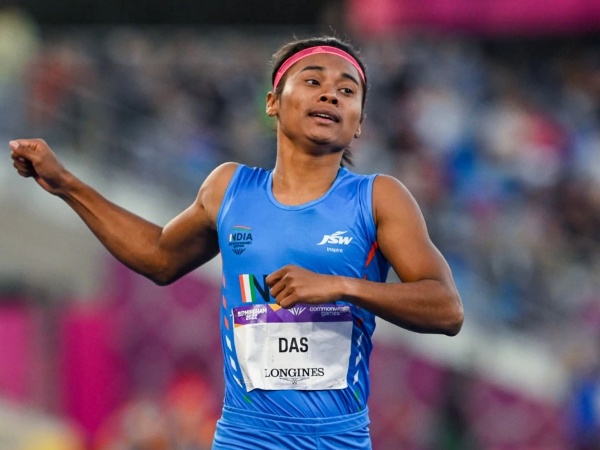
The National Anti-Doping Agency (NADA) decision to embarrassingly reverse the order of the National Anti-Doping Appeal Panel exonerating sprinter Hima Das of Whereabouts Failures appears to have been made under immense scrutiny and pressure from the World Anti-Doping Agency. Late on Tuesday, NADA updated its list of athletes sanctioned by ADAPs to include a 16-month ban for Hima Das, backdating the start of the ban to July 22, 2023. It mentioned that the ban had been imposed under a Case Resolution Agreement (Rule 10.8.2.) which allows for a reduced sanction at the discretion of NADA and World Anti-Doping Agency (WADA).
Curiously, reductions of ineligibility periods under Case Resolution Agreements can be arrived at only at the discretion of NADA and WADA, it would appear that WADA is okay with the decision to hand Hima Das a reduced 16-month ban and backdating it to start on what appears to be the day of the final of the three Whereabouts Failures.
Whereabouts failures are any combination of three missed tests and/or filing failures within a 12-month period by an athlete in a Registered Testing Pool. And this is one of the many anti-doping rules violation that attracts bans from sport.
Many questions surface around the handling of the case but the foremost has to be how can a Case Resolution Agreement be entered into by an athlete with NADA after an arbitration panel, let alone two, heard and adjudicated a case? Such agreed sanctions under Rule 10.8.2 can be arrived at only if an athlete admits an ADRV when first confronted by NADA.
By no account, did the 2018 Asian Games 400m silver medalist made an early admission of a rule violation. On the contrary, Hima Das challenged NADA’s allegation of Whereabouts Failures and preferred to be heard by a National Anti-Doping Disciplinary Panel (ADDP). In October 2023, Hima Das was placed under provisional suspension.
In April 2024, the ADDP exonerated Hima Das and allowed the athlete to return to competition. NADA’s appeal against that order did not find favour with an Appeal Panel. And just when dust seemed to have settled over the case, an update on NADA’s website suggests that WADA may have hinted at moving Court of Arbitration for Sport against the exoneration.
In a case involving Triple Jumper Reni Grewal, WADA appealed before CAS against an ADAP decision to exonerate her. CAS reimposed a four-year ban on the athlete and imposed 90 per cent of the cost of CAS proceedings on NADA. NADA also had to pay 3000 Swiss francs (approximately Rs 2.87 lakh) to WADA towards the latter’s legal expenses in this case.
In 2022-23, a WADA investigation named Operation Carousel looked into allegations that some of NADA’s testing programme was not in keeping with the requirements of the World Anti-Doping Code and international standards for testing and investigation and international standards for result management, revealed significant deficiencies in NADA.
In November 2022, WADA’s Intelligence and Investigation team pointed out to NADA that more than 25 per cent of the 131 athletes on the NADA RTP had either not made a Whereabouts Filing at the required times or had made a delayed Whereabouts Filing. NADA admitted to not registering a Whereabouts Failure in ADAMS against any of these athletes.
WADA also pointed out that as of November 17, 2022, as many as 28 of the 131 athletes on NADA’s RTP had not been tested at all through the year. In March 2023, NADA informed WADA that it had discovered 79 Whereabouts Failures were in the final stages of review. Two later, this number had increased to 97 Whereabouts Failures against 70 athletes.
Against such a backdrop, NADA and the National hearing panels would have been expected to tread on eggshells and ensure they stick to the rules. It would appear that in Hima Das’ case, NADA and the panels have lurched from error to error, causing the world body to step in an urge a review to avoid another reversal in CAS.
A full-blown appeal before CAS would have proved very expensive and brought more embarrassment for NADA. While it may have got WADA to agree to the Case Resolution Agreement with Hima Das, it can be sure that the world body will watch it even more closesly that before.